Uncomfortable Reading: the PEEL Inspection of Gloucestershire Constabulary
The HMICFRS PEEL 2025-27 inspection report into Gloucestershire Constabulary landed recently, and frankly it makes for grim reading. I sit on the Police and Crime Panel, so I've been through it properly, and it raises serious questions about how our county is policed and who should be held to account.
What the Inspectors Found
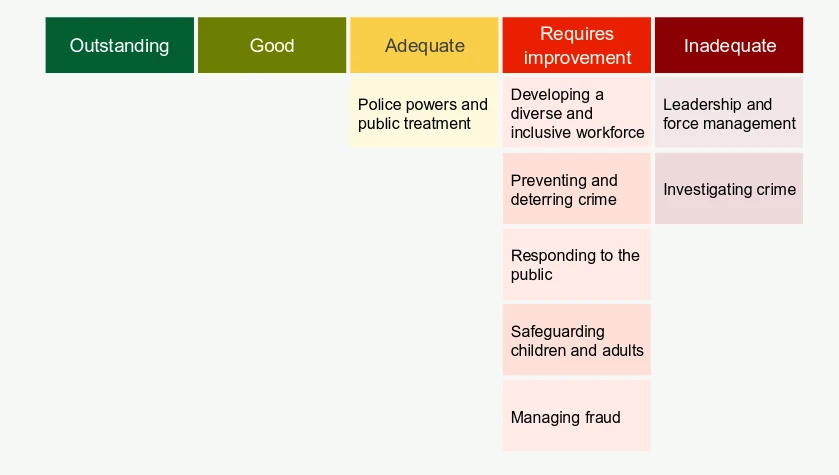
The report grades the force's leadership and management, and its investigation of crime, as inadequate. Most other areas, including safeguarding, responding to the public, and neighbourhood policing, require improvement. Only one area has improved since the last inspection. Several have got worse.
Two formal causes of concern stand out.
On leadership and management: the force's operating model is hamstrung by financial constraints and poor IT. A £10.5 million request to the Minister of State for Policing for essential funding was refused outright. The force is raiding reserves to balance the books. Meanwhile morale is rock bottom, with only around a third of staff surveyed saying they'd recommend the constabulary as a place to work, and many unable to take the leave they're owed.
On investigating crime: serious criminal investigations have been handed to officers who simply haven't had the training. As of April 2026, just 13 of 68 constables in the criminal investigation department held the accredited qualification for investigating serious crime. Open crime files rose from around 7,900 to 9,600 in a year. Fewer victims see their case end in a charge than in comparable forces.
There are bright spots. Stop and search has improved dramatically, with 98.4 percent of searches showing reasonable grounds. Emergency call answering has got better too. And on one point, the report confirms what I and others have been banging on about for ages: Black people were five times more likely to be stopped and searched than white people. But the overall picture is of a force that's under-resourced, overstretched, and struggling to deliver the basics for victims.
My Position on the Panel
I want to be constructive here. This isn't about kicking a force when it's down. It's about making sure the people of Gloucestershire get the police service they pay for and deserve.
Name the funding failure. The report is explicit that the constabulary faces extremely challenging financial circumstances, and that a direct request to government for investment in IT and infrastructure was refused. When the Panel scrutinises police performance, we must also scrutinise the government decisions that got us here. I'll be pressing for the Panel to put the funding context formally on record, and the PCC should be challenging ministers publicly with the evidence in this report.
Evidence, not assurances. HMICFRS has given the force six months to act on its recommendations. I want the Panel to get measurable progress reports against each one, with actual numbers: accredited investigators, open cases, neighbourhood officer abstraction. The reassurances we've had in the past were not enough.
Protect neighbourhood policing. Neighbourhood officers keep getting pulled away from their communities to plug gaps elsewhere, sometimes weekly. The report links this directly to weaker prevention and problem-solving. I want the force's own target of 85% of neighbourhood time spent on visible, community-focused work reported to the Panel every quarter, with someone senior, like the PCC, actually owning it.
Fairness and data integrity. Black people were five times more likely to be stopped and searched, and almost seven times more likely to have force used against them, compared with white people. Inspectors also found officers often don't ask people to self-define their ethnicity, meaning the force's own analysis may rest on inaccurate data. The inspectors were told that the external scrutiny panel does valuable work, though I've yet to see much evidence of that in what the Panel is shown about the Legitimacy Panel's activity. Scrutiny is only as good as the data behind it, as I raised at the last Panel meeting.
The Bigger Picture
I acknowledge, as the Chief Inspector did, that officers and staff are working under enormous strain. Most joined to serve their communities and are being let down by the conditions they work in. But sympathy isn't a substitute for standards. Victims of crime in Gloucestershire, particularly vulnerable victims, deserve better than unresolved cases and untrained investigators.
And as a Green, I'd add this:
The report shows exactly what happens when public services are hollowed out year after year. A police force that can't invest in its people, its systems or its communities can't keep people safe. The answer is proper resourcing rooted in prevention.
I'll be raising these issues at the Police and Crime Panel with what little agenda space we get to ask and I'll report back here.
Cllr Gareth Kitchen, Stroud District Council and Gloucestershire Police and Crime Panel