New NPPF and Edge-of-Village Development
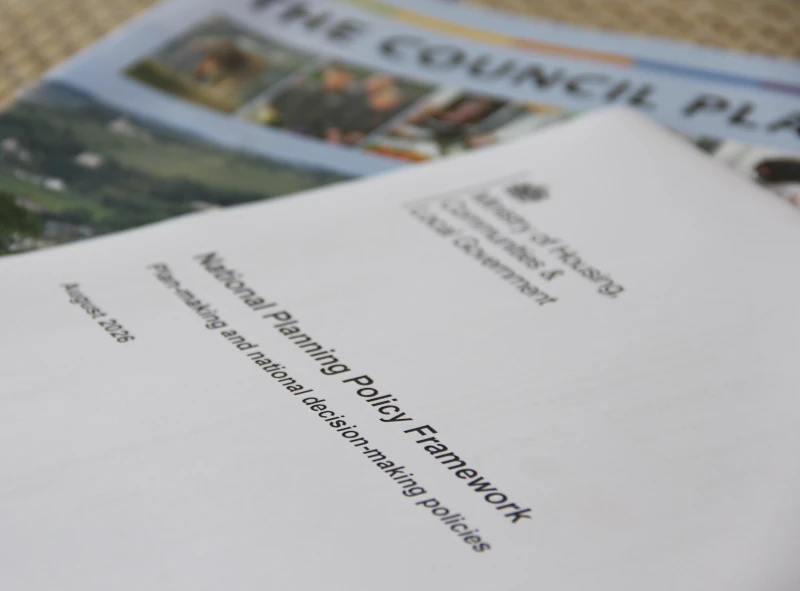
I thought it worth circulating this post from my Green Party colleague, Cllr Moya Shannon, over in Eastington. Even though we don't have a Neighbourhood Development Plan it maybe relevant to the Wotton Cluster.
It highlights the challenges Eastington have ahead following the latest National Planning Policy Framework (NPPF) updates — and the role a Neighbourhood Development Plan (NDP) plays in giving residents a voice.
The changes to the NPPF are not only about housing; they are also about residents' democratic right to a say in where they live.
Why refusal is now so difficult
Under the August 2026 NPPF, the chance of successfully refusing a housing application on the edge of a village — one with no five-year housing land supply and no up-to-date NDP — is extremely low.
The August 2026 framework explicitly removed the old “Paragraph 11(d) tilted balance” machinery and replaced it with a restructured, rules-based mechanism under Policies S3, S4 and S5. The core mechanism governing housing shortfalls, however, remains heavily weighted in developers' favour.
Policy S5(1)(j) — the new “tilted balance”
The old presumption in favour of sustainable development has been rewritten. Under Policy S5(1)(j), development outside existing settlement boundaries is fast-tracked where it addresses an “evidenced unmet need”:
- Where the local authority cannot demonstrate a five-year housing land supply (and may face a 20% buffer depending on the age of its Local Plan), an unmet need is automatically established.
- Under this national decision policy, the council's local settlement boundary policies are overridden. Permission must generally be granted unless the adverse effects substantially outweigh the benefits of doing so.
No protection from an out-of-date Neighbourhood Plan
Under the 2026 rules, a tightly drawn village boundary in an older NDP is no longer a valid shield against a housing supply shortfall. Under Policy S6, the benefits of approving housing development are only treated as substantially outweighed by adverse effects where the proposal conflicts with a neighbourhood plan that became part of the development plan five years or less before the decision and contains policies and allocations meeting its housing requirement. Without an up-to-date NDP, this vital statutory protection is entirely absent.
Edge-of-village geography favours approval
The 2026 NPPF shifts towards an objective, functional assessment of settlements rather than reliance on map lines. An edge-of-village plot is structurally the most vulnerable type of unallocated land:
- It is physically well related to an existing community, so it is rarely classed as “isolated rural housing”.
- It connects logically to local infrastructure and services, satisfying national sustainability criteria.
The only ways a refusal could stand
A council can only successfully refuse such an application if it can demonstrate technical, non-boundary harms severe enough to completely eclipse the housing shortfall. Under the 2026 framework, these are limited to:
- Explicit refusal triggers (Policy S5(2)) — restrictive local constraints trump the housing presumption only where the NPPF explicitly says development should be refused (for example, severe flood risk zones or the destruction of irreplaceable ancient woodland).
- Glaring design failure — the 2026 framework places greater statutory weight on design. A scheme that is wholly unintegrated, poorly designed, or lacking the necessary infrastructure contributions can be rejected on design grounds alone.
Official sources
- National Planning Policy Framework (published 17 August 2026, Ministry of Housing, Communities and Local Government) — guidance page: https://www.gov.uk/guidance/national-planning-policy-framework
- National Planning Policy Framework — full document (PDF): https://assets.publishing.service.gov.uk/media/6aabe97844ec1aa417346c0b/National_Planning_Policy_Framework.pdf
PS. I've made some amends to Moya's original post.